


Sawdust is one of the most omnipresent byproducts of the industry. Every sawmill, furniture factory, timber yard and construction site that works with wood generates it in vast quantities, and collectively, the world produces hundreds of millions of tonnes of it each year. Despite this abundance, sawdust remains underutilised. The most common disposal method is incineration for energy recovery, which while practical, carries a significant environmental cost such as burning wood waste releases back into the atmosphere the very carbon that the original trees spent decades absorbing.
For a material that is structurally cooperative, fibrous and widely available, it deserves far better than being treated primarily as a combustion problem. Over the years, it has found niche applications such as compressed firestarter cubes, and Pykrete, the experimental wood pulp and ice composite once which was considered as a hull material for an aircraft carrier. Now, researchers at ETH Zurich and Empa have developed a process that gives sawdust a genuinely compelling new purpose. Here is a detailed report on FURNITURE DESIGN AND TECHNOLOGY (FDT).
Doctoral researcher Ronny Kursteiner dedicated his thesis to creating a method that binds sawdust particles using struvite, a colourless crystalline mineral made up of ammonium magnesium phosphate. The key to making this work lies in a specialised enzyme derived from watermelon seeds, which governs how struvite crystals grow and interlock within the sawdust matrix. This enzymatic control is what sets this approach apart from earlier attempts.
Conventional precipitation techniques produce small, poorly organised crystallites that fail to grip wood particles effectively, causing earlier composites of this kind to break down mechanically. The watermelon seed enzyme, on the contrary, promotes the formation of large, interlocking crystals that physically fill the gaps between sawdust particles, creating a robust and cohesive structure.
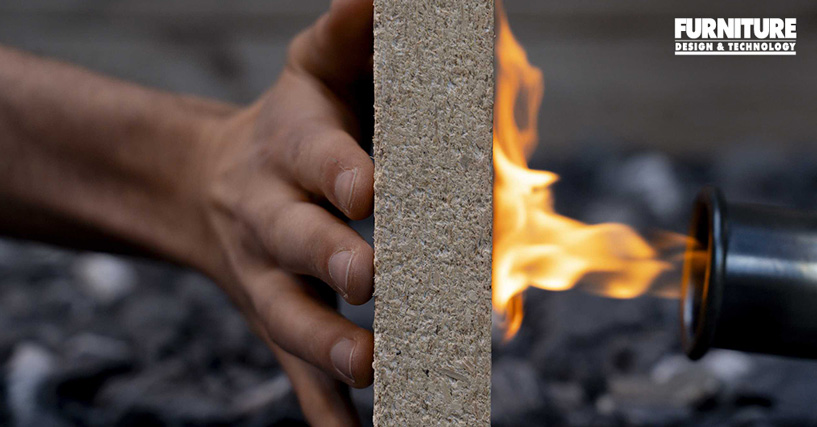
The resulting composite panel, which is cold-pressed over two days and dried at room temperature without the need for elevated curing conditions, is impressive on several fronts. In terms of compressive strength, it outperforms spruce timber, a widely used structural material. More striking still are its fire resistant qualities. When exposed to a direct flame, the panel holds out for more than three times as long as untreated wood. Cone calorimeter tests illustrated that untreated spruce ignited in approximately 15 seconds, while the struvite composite took between 45 and 51 seconds. The science behind this resistance is well understood that when heat reaches struvite, the mineral decomposes and releases water vapour and ammonia, which absorbs energy from the immediate environment. The resulting non-combustible gases displace oxygen, depriving the fire of what it needs to sustain itself, while simultaneously accelerating the formation of a char layer on the surface that slows the fire’s access to unburnt material beneath.
With a binder content of 40 per cent by weight, early projections place this material in the same fire protection category as cement-bonded particleboard, which currently dominates interior partition applications. However, full-scale testing is still ongoing. The composite is fully recyclable. At the end of its service life, panels can be ground down and gently heated to just above 100 degrees Celsius, at which point ammonia is released and the constituent materials separate cleanly, thus being ready for reuse or repurposing and can also be included as phosphorus-based fertiliser.
Image credit: ETH Zurich
Furniture Design India and the magazine FURNITURE DESIGN & TECHNOLOGY (FDT magazine) are from the trusted 22-year-old media house of SURFACES REPORTER and PLY REPORTER.
FDT is a B2B monthly bilingual magazine from India that shares the pulse of the furniture business in India and connects the manufacturers, OEMS, product designers, architects, showrooms, designers and dealers.
Read More
 Editorial
 Editorial
© 2026 Furniture Design and Technologies.. All Rights Reserved. Developed by eyeQ Advertising


