



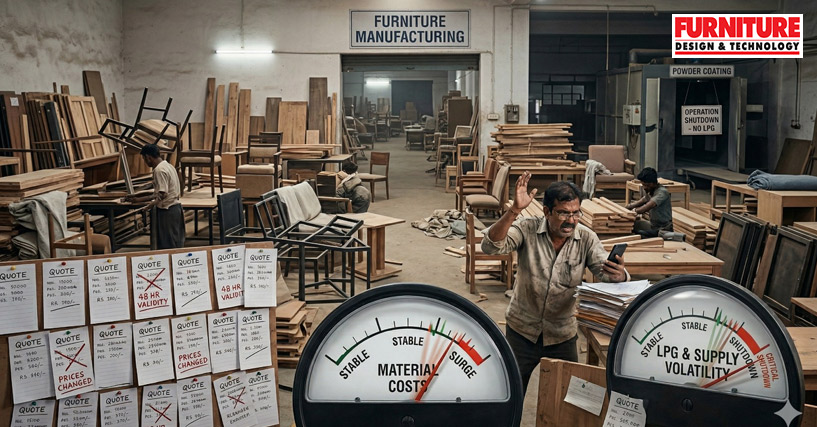
A perfect storm of volatile input costs, supply disruptions, and pricing uncertainty is pushing India’s furniture industry into an unprecedented reset moment reports SURFACES REPORTER (SR).
The ongoing Iran war is no longer just a geopolitical crisis -- it is rapidly becoming a manufacturing crisis, with ripple effects now reaching India’s furniture industry. What began as a sharp observation by industry player Prerak Mahajan on LinkedIn -- “The last 3 weeks in furniture manufacturing? Absolute chaos.” -- quickly unfolded into something much bigger. The comment section that followed reads less like a discussion and more like a collective industry signal: this is not a routine price fluctuation cycle -- this is a system-wide disruption.
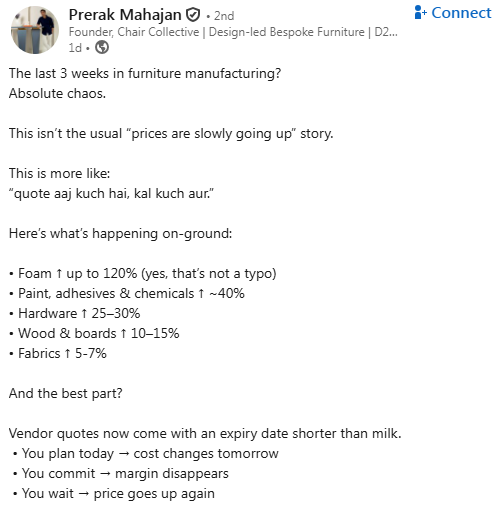
Prerak Mahajan, Founder, Chair Collective, summed up the situation succinctly: “The last 3 weeks in furniture manufacturing? Absolute chaos. This isn't the usual ‘prices are slowly going up’ story. This is more like: ‘quote aaj kuch hai, kal kuch aur.’”
He went on to outline the on-ground reality:
And as he noted, vendor quotes now come with an expiry date “shorter than milk,” where:
As seen above the numbers themselves are staggering. But what’s alarming isn’t just the increase -- it’s the speed and unpredictability.
As multiple industry voices echoed:
This has effectively made costing and forecasting unreliable, pushing manufacturers into constant recalibration.
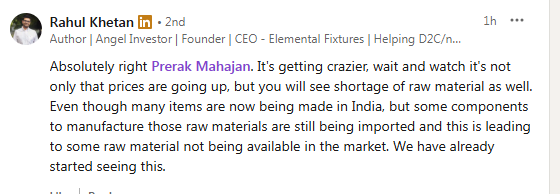
Reinforcing this growing concern, Rahul Khetan, Founder & CEO, Elemental Fixtures, observed that “it’s getting crazier… it’s not only that prices are going up, but you will see shortage of raw material as well,” pointing to the continued dependence on imported components that is now beginning to create visible supply gaps in the market.
Across the board, one theme dominates:
?? The biggest challenge isn’t higher prices -- it’s unpredictability.
One industry expert summed it up sharply:
“The only thing worse than a high price is an unreliable one.”
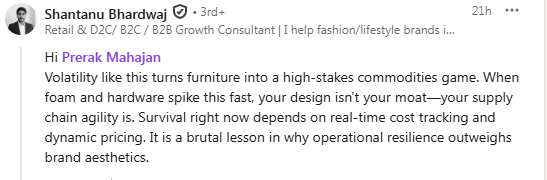
Expanding on this, Shantanu Bhardwaj, Retail & D2C/B2C/B2B Growth Consultant, noted that “volatility like this turns furniture into a high-stakes commodities game,” adding that when input costs spike this rapidly, “your design isn’t your moat -- your supply chain agility is,” making real-time cost tracking and dynamic pricing essential for survival.
Manufacturers are facing a dangerous squeeze:
This creates a widening gap where:
As industry analysis by PricePedia notes, “part of these higher costs was absorbed by producers themselves through margin compression,” reinforcing the growing pressure on profitability.
Production Is Getting Disrupted -- Not Just Expensive
The impact is severe:
This is no longer just a cost issue -- it’s a manufacturing continuity crisis.
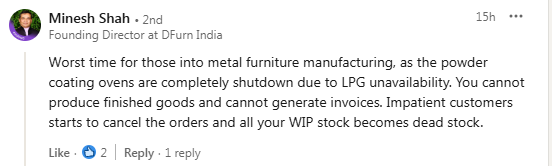
Highlighting the severity on ground, Minesh Shah, Founding Director at DFurn India, described it as the “worst time for those into metal furniture manufacturing,” noting that with powder coating units shut due to LPG shortages, businesses are unable to generate invoices while “all your WIP stock becomes dead stock.”
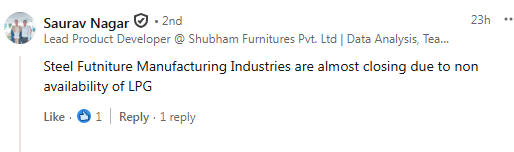
Similarly, Saurav Nagar, Lead Product Developer at Shubham Furnitures Pvt. Ltd., pointed out that steel furniture manufacturing units are “almost closing due to non-availability of LPG.”
Even as costs surge, manufacturers are struggling with customer perception gaps:
Architects and project stakeholders are now spending more time:
This expectation gap extends beyond the Indian market. As Juvencio Maeztu, CEO of Ingka Group (IKEA’s largest franchisee), noted, “consumers… want to have stability in prices,” highlighting the fundamental mismatch between volatile input costs and customer expectations of consistency.
Several deep structural cracks are becoming visible:
This growing uncertainty is also reflected globally. As a furniture industry executive told The Washington Post, “the most difficult question… is, ‘how much is that going to cost?’… ‘it depends,’” underlining how pricing itself has become a variable rather than a constant.
A powerful shift is emerging across the discussion:
This phase is not about design, brand, or speed anymore.
Instead, survival depends on:
Or as one industry voice stated:
“Design is no longer the moat -- supply chain agility is.”
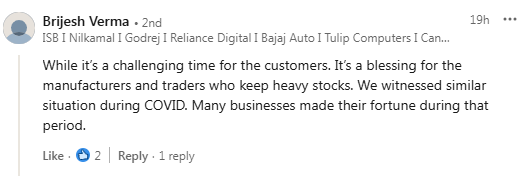
Offering a counterpoint, Brijesh Verma, with experience across multiple consumer and retail organizations, noted that while this is a challenging time for customers, it can be advantageous for businesses holding inventory, drawing parallels with the COVID period when stock-heavy players were able to capitalize on disruption.
In the light of the emerging developments clear tactical responses are taking shape:
At a broader level, this shift reflects a deeper structural issue. As Jonathan Byrnes, MIT supply chain expert, observed, “many supply chains are perfectly suited to the needs… 20 years ago,” suggesting that legacy systems are no longer equipped to handle current volatility.
Amid the stress, some voices point to opportunity:
As highlighted in industry insights from Lakdi.com, “disruptions… present opportunities for innovation and growth,” reframing the current phase as a potential transformation moment.
This disruption is not isolated to furniture:
Industry analysis by PricePedia notes that “volatility of raw-material and energy prices… created a climate of uncertainty,” reinforcing that this is part of a broader global shift.
And perhaps the most telling sentiment came from within the industry itself:
“Survival mode turned on.”
This phase is quietly testing something deeper than margins:
As Gary Friedman, CEO of RH (Restoration Hardware), cautioned, “significant inflation… will accelerate into 2026 and beyond,” reinforcing that the uncertainty facing the industry is not temporary, but structural.
Because in today’s furniture manufacturing landscape,
the winners will not be those who planned best --
but those who adapt fastest to a constantly shifting ground.
Editorial Disclaimer
This article has been compiled using publicly available information sourced from platforms such as LinkedIn, Google, and various news media reports, along with insights and inputs from the Furniture Design & Technology (FDT) editorial team. While every effort has been made to ensure the accuracy and relevance of the information presented, the content is intended solely for general informational purposes and to provide industry perspective.
The views, analysis, and interpretations expressed in this article are based on available data at the time of publishing and are subject to change as new information emerges. Furniture Design & Technology (FDT) does not claim responsibility for any inadvertent errors, omissions, or changes in developments after publication.
This article is not intended to serve as professional, financial, or business advice. Readers are encouraged to independently verify information and exercise their own judgment before making any decisions based on the content.
All trademarks, names, and references mentioned remain the property of their respective owners.
Furniture Design India and the magazine FURNITURE DESIGN & TECHNOLOGY (FDT magazine) are from the trusted 22-year-old media house of SURFACES REPORTER and PLY REPORTER.
FDT is a B2B monthly bilingual magazine from India that shares the pulse of the furniture business in India and connects the manufacturers, OEMS, product designers, architects, showrooms, designers and dealers.
Read More
 Editorial
 Editorial
© 2026 Furniture Design and Technologies.. All Rights Reserved. Developed by eyeQ Advertising


